Nestled in the heart of the Mediterranean lies a destination where turquoise waters meet millennia-old stories. This island, Italy’s second-largest, boasts a mosaic of influences shaped by its strategic position and resilient communities. While famous for pristine beaches, its true magic lies in traditions preserved through generations—from mysterious stone towers to vibrant festivals echoing ancient rhythms.
Visitors discover more than scenic beauty here. Bronze Age settlements whisper tales of early inhabitants, while medieval architecture reveals layers of Spanish and Roman influence. Local dialects still carry traces of forgotten languages, and UNESCO-recognized music fills village squares during seasonal celebrations. These elements form a living narrative that defines the region’s unique character.
Our guide illuminates how this destination balances preservation with evolution. Travelers gain access to archaeological wonders often overlooked by mainstream tourism, alongside opportunities to engage with artisans keeping traditional crafts alive. Every corner offers insights into how geography and history intertwine to create an identity distinct from mainland Italy.
Key Takeaways
- Discover Bronze Age ruins and medieval architecture revealing layered historical influences
- Experience UNESCO-recognized musical traditions during local festivals
- Explore less-crowded archaeological sites offering authentic cultural immersion
- Understand how Spanish, Roman, and indigenous elements shape local dialects and customs
- Learn about preservation efforts maintaining traditional crafts and practices
The Historical and Cultural Landscape of Sardinia
Bronze Age mysteries whisper through weathered stone structures that dot the island’s rugged terrain. These silent witnesses tell stories of early societies who shaped the land’s identity through innovative craftsmanship and spiritual connections to nature.
Ancient Traditions and Indigenous Roots
The island’s roots stretch back to the Nuragic people, whose towering stone towers still dominate the horizon. These Bronze Age communities perfected dry-stone construction techniques, creating fortified villages that served as social hubs. Their spiritual practices blended celestial observations with earth-based rituals, elements still echoed in local festivals.
Farmers and shepherds preserved ancestral knowledge across generations. Seasonal planting methods and wool-working traditions survived foreign invasions, maintaining a tangible link to pre-Roman history. Even today, artisans craft intricate textiles using patterns unchanged for millennia.
Evolution Through the Centuries
Conquerors from Rome to Spain left their marks without erasing local identity. Roman roads connected villages, while Spanish Gothic arches adorned churches built atop ancient sacred sites. Linguistic blends emerged, mixing Catalan phrases with indigenous dialects.
Centuries of adaptation created a unique fusion. Pagan harvest celebrations evolved into Christian feasts honoring patron saints. Traditional music absorbed Mediterranean rhythms yet retained its haunting vocal style. This resilience transformed external influences into threads within Sardinia’s living cultural tapestry.
Deep Dive: sardinia cultural heritage
A living tapestry of traditions unfolds across this Mediterranean island, where ancient rhythms pulse through modern community life. Its cultural heritage thrives not in museums but in village squares and family workshops, creating an identity shaped by resilience and adaptation.
Defining the Island’s Unique Identity
Four voices harmonizing in raw, guttural tones reveal the soul of Sardinian expression. The UNESCO-protected Canto a Tenore—a haunting blend of Spanish guitar and indigenous melodies—exemplifies how the island absorbs influences without losing its core character. This art form, practiced by shepherds for centuries, remains a vital part of social gatherings today.
Linguistic diversity strengthens this distinctiveness. In Alghero, Catalan phrases mingle with local dialects, while ancient Nuragic words surface in rural conversations. Such language preservation acts as both a time capsule and a bridge between generations.
Significance in Global Cultural Narratives
Beyond postcard-perfect landscapes lies a cultural heritage offering lessons for the modern world. The island demonstrates how isolated communities can maintain authenticity while engaging globally. Traditional textile patterns, for instance, now inspire Milanese fashion designers.
UNESCO’s recognition of Sardinian traditions underscores their universal value. As one ethnomusicologist notes: “These practices show humanity’s capacity to transform survival into art.” Through festivals and crafts, the island contributes unique perspectives to humanity’s shared story—proving cultural richness isn’t measured by size, but by depth of experience.
Architectural Marvels and Nuragic Legacy
Rising from the Mediterranean scrublands, stone sentinels guard secrets of a vanished civilization. These Bronze Age structures stand as testaments to ingenious engineering, blending seamlessly into rugged landscapes. Among them, Su Nuraxi di Barumini emerges as the pinnacle of Nuragic achievement—a labyrinth of history frozen in volcanic rock.
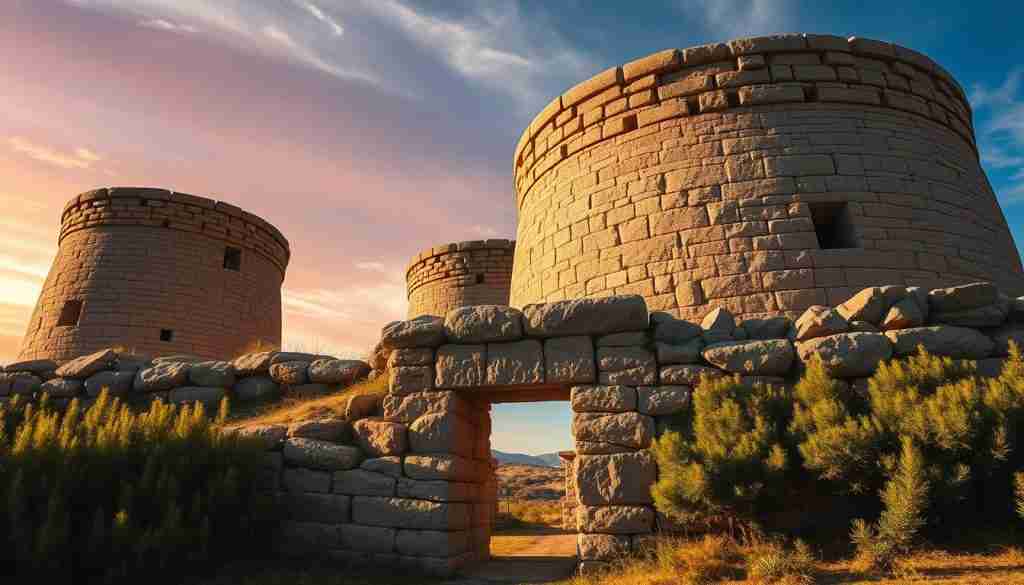
Su Nuraxi di Barumini: A Timeless Wonder
The central tower’s corbel-vaulted chambers reveal Bronze Age mastery. Builders stacked basalt blocks without mortar, creating a 60-foot fortress that defied time and earthquakes. A spiral staircase connects three levels—each chamber serving distinct purposes in ancient communal life.
Excavations show continuous use from 1600 BCE through the Roman era. Layers of pottery and tools map societal shifts across 30 centuries. “This site rewrote our understanding of Mediterranean prehistory,” notes archaeologist Giovanni Lilliu, who led 1950s excavations.
The Legacy of Nuraghi in Historical Defense and Society
Over 7,000 nuraghi once dotted the island, forming Europe’s densest Bronze Age network. These structures evolved from clan strongholds to regional hubs. Their strategic placement controlled trade routes and farmland, fostering interconnected communities.
Modern protection efforts balance preservation with access. Laser mapping and climate-controlled shelters now shield ancient stones. As UNESCO safeguards this place, visitors walk where warriors once patrolled ramparts—experiencing living history through tactile architecture.
Music, Festivals, and Cultural Expressions
The island’s heartbeat pulses through its music and seasonal celebrations. These living traditions transform town squares into stages where past and present merge through sound and movement.

Traditional Music and the Role of Cantadores
Four voices intertwine in the Canto a Tenore, echoing shepherds’ calls across valleys. This UNESCO-protected art form uses distinct vocal ranges—Bassu’s rumble mimics cattle, while Mesu Boche’s high notes mirror bird songs. Cantadores groups perform in historic villages, their harmonies flowing through cobblestone streets like auditory time capsules.
Iconic Festivals: Sa Sartiglia to Mamuthones
Oristano’s Sa Sartiglia dazzles with masked riders on decorated horses. Competitors in ornate costumes spear rings at full gallop—a medieval spectacle blending Spanish pageantry with agrarian rituals. In Mamoiada, the Mamuthones procession chills spectators. Bronze cowbells clank as dancers in wooden masks perform hypnotic dances to dispel darkness.
Modern Celebrations Rooted in Ancient Rites
Today’s festivals balance tradition with innovation. As one organizer notes:
“Our rituals aren’t museum pieces—they’re evolving conversations with history.”
While socialmediaspreads awareness, communities safeguard sacred elements. Nighttime processions now use LED-lit costumes, yet maintain ancestral choreography and symbolic gestures.
These events create bridges between generations. Young musicians reinterpret folk melodies with electric instruments, while elders ensure ancient lyrics survive. Through this dynamic exchange, the island’s expressions remain vibrant yet authentic.
Cultural Trails: Exploring Ancient Towns and Coastal Villages
Winding paths lead travelers through living history along the island‘s western coast. Here, cobblestone streets and weathered facades reveal stories of conquest and adaptation. Alghero emerges as a crown jewel—a town where Catalan echoes blend with Mediterranean breezes, offering visitors a portal to 14th-century Spain.
Historic Centers and Traditional Markets
The Church of San Francesco stands as a masterpiece of Catalan Gothic design. Its cloister’s slender columns frame skyward arches, while carved capitals depict biblical scenes with Sardinian flair. Nearby, the Cathedral of Santa Maria towers over Piazza Duomo—its belltile mosaic patterns mirroring the natural beauty of nearby coral reefs.
Alghero’s markets burst with authenticity. At Mercato Civico, fishermen display ruby-red coral jewelry alongside octopus catches. “Our craft connects sea to soul,” shares a fourth-generation artisan, polishing a pendant shaped like ancient Nuragic towers. These spaces preserve trade traditions while welcoming modern visitors.
Festivals transform the city into living theater. During Festes de Sant Miquel, costumed processions wind through alleys to tambourine rhythms. Locals serve paella algherese—a savory reminder of Aragonese rule—from family recipes unchanged for six centuries.
Beyond Alghero, villages across the island maintain distinct identities. Bosa’s pastel houses climb toward Malaspina Castle, while Castelsardo’s hilltop fortress hosts weekly lace-making demonstrations. Each place offers fragments of a larger mosaic—regional pride preserved through architecture, language, and hands-on traditions.
Experiencing Natural Beauty and Culinary Delights
Azure waves kiss shores where golden sands meet rugged cliffs, crafting a masterpiece of natural beauty. Beyond ancient stone towers and festivals, the island reveals another dimension through its untouched landscapes and flavors rooted in pastoral traditions.
Stunning Beaches, Landscapes, and Coastal Life
Costa Smeralda’s crystalline waters rank among Earth’s most dazzling beaches. Hidden coves like Spiaggia del Principe offer secluded swimming spots framed by pink granite boulders. Coastal trails wind through juniper-scented maquis, where shepherds still guide flocks along age-old paths.
Inland, cork oak forests shelter wild boar herds. Visitors can join sunset boat tours spotting dolphins near La Maddalena archipelago. These places showcase how geography shapes daily life across the island.
Authentic Sardinian Cuisine and Artisan Crafts
Wood-fired ovens produce pane carasau—paper-thin bread perfected over millennia. Family-run agriturismi serve porceddu, succulent roast pig seasoned with myrtle. Dessert brings seadas: crispy pastries oozing pecorino cheese, drizzled with local honey.
Artisans preserve ancient techniques in red coral jewelry and handwoven textiles. Their art reflects a bond between land and communities. As one silversmith notes: “Every filigree twist tells our ancestors’ stories.”


